My Photo

photo courtesy of www.fivepondsfarm.com

All Rights Reserved

May 11, 2008

Soft-shell Crab

Crab3


It's soft-shell crab season!  Soft-shell crabs are not a distinct species of crab.  It just means the crab was caught when it was molting.  The crab sheds its hard shell in order to grow and form a new shell.  If the crab is caught during this time the result is the delicacy known as the soft-shell crab.  In my region the soft-shell crab is the blue crab native to the Chesapeake bay watershed.

Melanie and I love eating soft-shell crab together.  Though, for me it brings back memories of our date that never happened.  Before we officially got together I tried to make my move...unsuccessfully.  I'm pretty sure if she hadn't canceled the soft-shell crab date we would have started our relationship a year before we actually did.  But then I would never have moved to New York.  Of course that would mean I wouldn't have had to suffer the heart-ache of a long distance relationship before moving back to DC. 

Maybe I should finally believe that she wasn't ready for a relationship at the time of the soft-shell crab date that never happened.  I guess I can be okay with my lifetime of happiness starting a year later than it could have.  The next time I serve soft-shell crabs I'll try to serve them without bitterness.  But if Melanie gets a lemon seed on her crab she'll now know why.


Pan fried soft-shell crab


Ingredients:

soft-shell crabs

salt

pepper

flour

olive oil

1 lemon

If the crabs are alive kill them quickly and humanely by taking a sharp pair of scissors or a knife and cutting the front portion off right behind the eyes.  To clean the crab you'll also want to remove the gills  that you'll find by lifting up the side flaps.  Then flip the crab over and cut off the triangular flap tucked underneath.  Remove as much of the yellow stuff that is coming out of the crab as you can easily.  It's not necessary to remove all of this.  The crab is now ready to cook.

Put a thin even layer of olive oil in a large skillet.  Place over medium-high heat.  Season the crabs with salt and pepper to taste.  Lightly dust in flour, making sure to cover all parts of the crab.  Pan fry the crab for about 3 minutes per side, or until the crab turns red and the coating turns golden.  Spritz a little freshly squeezed lemon juice on top and serve.

May 06, 2008

Learnapalooza DC

My friend Steph and I will be hosting a discussion this Saturday on the benefits of eating from local small farms.  This discussion is part of Learnapalooza, a day of interesting classes taught in several locations around northwest DC.  Our class is at Hoopla in Adams Morgan (2314 18th St. NW Washington, DC 20009 (202) 797-0730) at 1pm.  A friend of mine is also teaching a class right before us at noon at Hoopla on how to run your diesel car on deep-fryer grease.  Stop by if you get a chance!

May 04, 2008

Mache, Asparagus and Pistachio Salad

Mache5

This is a wonderful spring salad, which makes great use of freshly picked asparagus.  Use purple asparagus if you can find it.  If you're not familiar with mache, also known as lamb's lettuce, it's a mild green with a slightly sweet, flowery taste.  It pairs well with the raw asparagus, pistachios, and parmesan cheese in this salad.

Mache, Asparagus, and Pistachio Salad (serves 4)
from The Zuni Cafe Cookbook: A Compendium of Recipes and Cooking Lessons from San Francisco's Beloved Restaurant

Ingredients:

2 tablespoons roasted pistachios

1/4 cup extra-virgin olive oil

1 tablespoon champagne vinegar or white wine vinegar

salt

4 spears jumbo asparagus, tips removed and saved for a different use

4 to 5 ounces mache, washed and dried

1 ounce chunk Parmesan cheese


Coarsely chop the pistachios, removing any discolored nuts.

Combine oil, vinegar, and salt to taste.

Slice asparagus at a steep angle, starting at the tip end, into 1/8 inch thick ovals.  Stop slicing if end becomes woody.

Toss the mache, asparagus, and pistachios with enough vinaigrette to lightly coat.  Taste and adjust seasoning as needed.  Divide salad among cold plates, leaving some pistachios in the bowl.  Use a vegetable peeler to shave small curls of the cheese over the salad.  Sprinkle the rest of the pistachios on top and serve.

April 30, 2008

Grilled Shrimp with Pickled Chili Salad and Miso Glazed Bacon

Top_chef_shrimp

Fans of the television show Top Chef will recognize this dish.  This shrimp dish certainly spiced things up with the contestants.  The dish has four Asian themed components:  spicy marinated grilled shrimp, pickled chili peppers and cukes, miso glazed bacon, and deviled aioli.  The team of Lisa Fernandes, Dale Talde, and Stephanie Izard created this dish to win the challenge during episode 5 of season 4.  The theme of the episode was The Elements, with this dish representing "fire".  In addition to winning the challenge one of the members of the winning team was rewarded with a trip to Italy for creating the best component of the dish.  This prize went to Lisa for her miso glazed bacon.  Dale was unhappy about this result, but I didn't think it was completely unexpected.  Did Dale really expect to win a trip to Italy for making a pickled pepper garnish?  Then again, his original recipe called for 7 pounds of peppers, so maybe he thought they should take center stage.

When I made this for Melanie and K a couple weeks ago, the bacon certainly was the star!

Grilled Shrimp with Pickled Chili Salad and Miso Glazed Bacon
(makes an appetizer for 4)

adapted from Top Chef Episode 5 Season 4

Ingredients:

Pickled Chili Relish:
5 chili peppers of different colors
5 mini bell peppers of different colors
1-1/4 cup rice wine vinegar
1/2 cup mirin
1/2 cup sugar
1-1/2 teaspoon salt
1 English cucumber sliced thin
3/4 cup canola oil
1/8 cup sesame oil

Shrimp:
8 jumbo shrimp, peeled, deveined
2 cloves garlic
1-1/2 teaspoons ginger, minced
2 tablespoons extra-virgin olive oil
1 teaspoon sambal, chili garlic
Salt and pepper to taste

Deviled Aioli:
1 egg yolk
1/2 teaspoon dijon mustard
1 cup canola oil
2 eggs, hardboied, whites discarded
1-1/2 teaspoons lemon juice
1/4 teaspoon sambal
1/2 teaspoon garlic chili sauce
1/2 teaspoon soy sauce

Miso-glazed Bacon:
4 thick cut bacon strips
1/2 cup shiro (white) miso
1/4 cup maple syrup
1 cup rice wine vinegar
3/4 cup mirin

Pickled chili relish:
Choose a colorful array of peppers.  If you like your food spicy add more chili peppers per bell pepper or vice versa.  Slice peppers into 1/8-inch thick rings using a mandolin or sharp knife.  Slice cucumbers into 1/8-inch slices.  Wash pepper rings repeatedly under cold water to remove seeds and inner rind.  In a sauce pot bring vinegar, mirin, sugar and salt  to a simmer.  When sugar is dissolved remove from heat.  Pour over peppers and cucumbers.  Let marinate for an hour.  Bring oils to smoking poing and pour over peppers and cucumbers.

Shrimp:
Mix all ingredients together and toss with shrimp.  Let sit in fridge for at least one hour then grill over high heat about 2 minutes per side.

Deviled Aioli:
In a bowl mix egg yolk with dijon mustard.  Slowly whisk in oil, pouring in a very slow, until thickened like mayonnaise.  Don't cease from whisking until all of the oil is incorporated.  Push hardboiled yolk through the small side of a cheese grater and add to mayonnaise.  Whisk in the remaining ingredients.

Miso-glazed Bacon:
Preheat oven to 375F.  In a heavy saucepot whisk together miso, syrup, wine vinegar, and mirin and bring to a boil over high heat.  Reduce heat to medium-low and reduce sauce until thick and glossy, about half an hour.  Meanwhile lay bacon on parchment paper and place on a baking sheet.  Cover bacon with another sheet of parchment paper.  Place a smaller baking sheet on top of bacon and weigh down with a heavy casserole dish.  Place in preheated oven and bake for 11 minutes.  Remove bacon and lay on a new sheet pan with parchment paper.  Heavily glaze bacon with miso sauce.  Return to oven and bake for 2 to 3 minutes.  Peel glazed bacon off parchment to serve.

Plating the dish:
Put a spoonful of aioli in the middle of the plate and drizzle a bit more around the edge.  Place 2 shrimp in the center of each plate.  Top with a few peppers and a cucumber slice or two, pickling juice drained.  Place a strip of miso-glazed bacon along-side shrimp.


April 27, 2008

This is the Dawning of the Age of Asparagus

Asparagus

Spring is officially here.  I know this because I saw asparagus, for the first time this year, today at the farmers market.  What is Spring without asparagus?

The asparagus is so fresh and delicious I haven't been able to resist eating it raw, stalk by stalk.  Maybe later this week I'll be inspired to do some asparagus recipes that are more involved than:  wash asparagus and eat.

April 26, 2008

How to Cure and Smoke Bacon

Bacon1

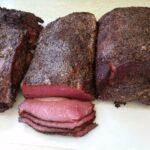
Bacon is surprisingly easy to make and especially delicious when you make it yourself with a pork belly from a small farm.  Choosing a pork belly from a well treated pig will give you a leaner and firmer bacon than the factory farmed equivalent in your local grocery store. The only "special" ingredients that you need are said pork belly, pink salt also known as Instacure #1, dextrose, and wood chips if you choose to smoke the bacon.  You can use regular sugar instead of dextrose, but add a little more than half as much if you do.  The pink salt has nitrite, which in addition to preserving the red color of meat and keeping fat from becoming rancid, prevents many bacteria from growing, including the bacteria responsible for botulism.  It's possible to cure bacon without pink salt, but it's safer to include it. 


Fresh Bacon

recipe adapted from:  Charcuterie: The Craft of Salting, Smoking, and Curing

Ingredients

Pork Belly (about 5 pounds)

1/2 cup maple syrup

2 TB Kosher Salt

1-1/2 TB dextrose (or 2-1/2 teaspoons table sugar)

1/2 TB pink salt

Mix dry ingredients together.  Place pork belly in large bag, preferably ziplock, and dump in dry ingredients.  Shake around and spread the salt mixture evenly over the pork belly.  Dump in maple syrup and spread over pork belly.  Refrigerate for 7 days, shaking the bag around every day or two.  You should feel the belly getting firmer with time.  After a week the belly should feel firm at its thickest point.  If it doesn't, refrigerate for a couple more days.

Remove pork belly from bag and rinse thoroughly.  Roast pork belly in grill over indirect heat with wood chips in foil pouch or smoker tray.  Apple, cherry, or maple wood is preferable.  Alternatively you may roast the bacon in a 200F oven.  Roast bacon until the internal temperature is 150F, 2 to 3 hours.  Start checking the temperature after 1-1/2 hours.

If bacon has skin or rind remove it while it's hot.  Try a slice of bacon now.  Yum!
Let bacon cool to room temperature.  Wrap in plastic wrap and put in ziplock bag.  Refrigerate for up to 2 weeks or freeze for up to 3 months.

Bacon_slab


April 22, 2008

Monsanto is French for "Pure Evil"

If you read The Ethicurean or similar sources frequently you've probably heard a lot about Monsanto.  If you want to hear more about why a lot of people don't agree with this company's practices check out this video by French filmmaker and journalist Marie-Monique Robin, which aired on French television last month.  Thanks K- for passing this along!

April 20, 2008

Simple Pleasures: Dandelion Greens

Dandelion_greens

Dandelion is a plant that I've encountered often.  I've typically encountered it as a weed in my yard or taking over the plot in my attempts at gardening.  However, if health were my biggest concern it might be better to eat this weed than to eat what I'm intentionally gardening.  Dandelion is higher in most vitamins and antioxidants than almost any plant that you'll find in your grocery store's produce section.  And every part of the dandelion is edible.  The flowers can be used in salads, battered and fried or to make the dandelion wine.  The tap root can be used in soup, and the crown(the top of the tap root) and greens can be used in salads or sauteed.

Dandelions contain more beta-carotene than carrots and more iron and calcium than spinach.   They also contain extremely high levels of antioxidants.  It makes sense that wild plants contain higher levels of nutrients that farmed plants.  Wild plants live in more diverse soil than most farmed plants that are given chemical fertilizer which has large doses of nitrogen, potassium, and phosphorous, and little else.  This is the reason why organic plants have a higher nutrient content than non-organic.  It also makes sense that wild plants have higher levels of antioxidants than farmed plants.  Some antioxidants are the plants defense against pests.  A wild plant needs to have higher levels of these than plants that have people taking measures to keep pests away. (More information about this and related topics can be found in:  In Defense of Food: An Eater's Manifesto)

Dandelion

Dandelion greens can be purchased at the farmers market  or picked from your yard.  If you pick them yourself be sure that the lawn isn't treated with chemicals.  It is best to pick the greens when the plant is very young and before the flower appears.  To cook simply sautee in olive oil with salt and pepper to taste.  Add some garlic or onion if you like.  Dandelion greens can be bitter, especially when not picked early.  Because of this they may be more enjoyable sauteed with spinach or a similar mild green.  Vinegar can be added to cut the bitterness as well (thanks for the tip hon).  If used in salads the greens work well paired with a strong cheese.

April 07, 2008

Yorkshire Pudding

Yorkshire_pudding

I first made Yorkshire pudding a couple of weeks ago with a delicious rib roast.  Unfortunately we were so hungry and the meal was so good that we forgot to take any pictures of the roast or the Yorkshire pudding.  The Yorkshire pudding was so delicious, and surprisingly easy that I was quick to make it again.  Yorkshire pudding is a savory pudding.  It's not quite stuffing, not quite quiche, but somewhere in between.  It's a good accompaniment to a roast, especially since this recipe calls for the reserved fat from the pan drippings of a roast.  You can substitute lard or butter for the reserved fat from a roast.

Pudding1
Yorkshire Pudding
from Jacques Pepin Celebrates by Jacques Pepin

Ingredients:
1/4 cup reserved fat from beef or pork roast
2 tablespoons peanut oil
1 large leek trimmed, washed and sliced (about 2 cups)
3/4 cup all-purpose flour
4 large eggs
1-1/2 cups milk
1-1/2 teaspoons salt
1/2 teaspoon freshly ground pepper
1/2 cup chopped parsley leaves

Preheat oven to 400F.  In a large, ovenproof, preferably nonstick skillet (9 to 10 inches in diameter) heat the reserved fat and peanut oil over medium heat.  When hot add the leek and saute gently for 2 to 3 minutes.  (click here for how to slice the leek) Meanwhile whisk the flour and eggs together in a mixing bowl until smooth.  Stir in the milk, salt, pepper, and parsley.  Add this batter to the leeks in the skillet.  Bake in the oven for 30 minutes then reduce the heat to 350F and cook for another 10 minutes.

If using a nonstick skillet invert pudding on a flat lid and flip back right-side up on a serving dish.  I used a stainless steel skillet and it was easier to just serve it out of the skillet.


March 28, 2008

How to Chop a Leek

Whole_leeks_2

Leeks are one of the more delicate and beautiful members of the onion family.  Melanie and I recently watched a few episodes of the The French Chef.  In one of the decades-old episodes Julia Child mentions how difficult it is to find leeks in this country and that onions can be used as a replacement.  Leeks are no longer difficult to find in this country, yet they still are not commonly used.  Melanie uses the word "intimidating" to describe leeks (she also finds doing the dishes "intimidating").  She's right about the leeks, though; they certainly can be scary. So I'm dedicating a whole post to the proper preparation of leeks.  I hope when Melanie reads it she feels less intimidated by this beautiful onion cousin. I'm less hopeful about her relationship with the dirty dishes.

What follows is how to properly trim, clean, and chop a leek.  With this skill in hand there's no reason to avoid the leek.
Trimmed_leek

First grab the leek by the root end and whittle away the dark green parts using a sharp knife.  When done trimming the leek will be slightly pointed at the end and only have light green, yellow, and white parts, as pictured above.
Leek_quartered

Cut the root off of the leek.  Next chop the leek in two, cross-wise, separating the green part from the white part (some very light green or yellow can be included in the white part).  Most recipes will mention whether to include the white parts only or the green and white.  The white is more delicate and the green is tougher and is often only included in soups and dishes that cook slowly.  Cut the white portion of the leek in quarters lengthwise.
Julienne_leek

Keep the leek quarters in layers; fold them over and slice thinly (Julienne).  Or chop to desired size.  Do the same with the green parts, paying attention to whether your recipe calls for keeping the green and white together or separate. 
Wash_leeks

It is important to wash leeks thoroughly as they can be quite gritty inside.  Put the chopped or Julienned leek in a strainer and wash well.  Towel dry the leek and it's ready to add to your favorite dish.